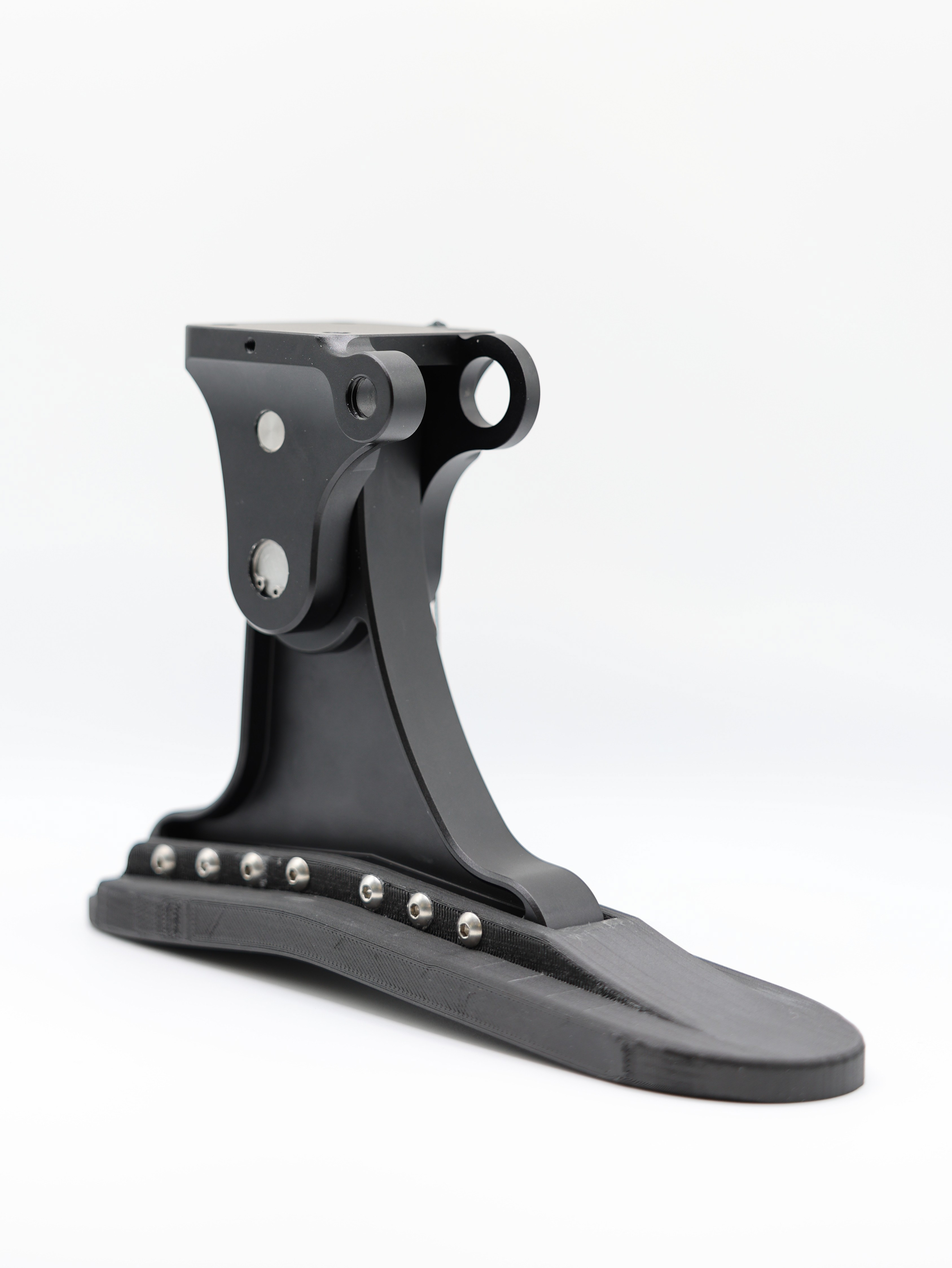
Two connected pieces of work. First, I designed and built Tamatoa, an 18-degree-of-freedom amphibious hexapod with a novel longitudinally-rotating hip joint that lets the robot tilt its body to an arbitrary azimuth and elevation. The idea is that a robot, like a shore crab, could angle itself into oncoming waves and let hydrodynamic forces push it *down* into the sand instead of over. Second, using that platform, our group ran a study of how the feet should move: six different foot paths tested underwater in sand, with and without waves, published in Biomimetic and Biohybrid Systems in 2024. They found that gripping inward with the front legs only, along a smooth curved swing path, cuts the cost of transport in half.
The transition zone, the strip between dry beach and fully submerged terrain, is a challenging region for robots. In the surf zone you need to contend with waves whose vertical lift force can exceed the weight of the animal or robot standing in them. Shore crabs live there comfortably, and one thing they do is change posture between terrestrial and aquatic stances to manage drag and acceleration-reaction forces. My hypothesis: a hexapod that can angle its body the same way should be able to cut its cost of transport in the transition zone.
The current (at the time) research platform in the Biorobotics Lab
Sebastian was the lab's existing amphibious hexapod: 18 DoF, with a hip, knee, and independent gripping dactyl on each leg, already producing good data on gait efficiency and transition-zone locomotion. Sebastian's joints can't rotate longitudinally, so it can tilt sideways but cannot change stance angle in the forward direction, which rules out exactly the postures I wanted to test.
The simpler of the two body angles. Walking sideways, I can raise or lower the body by computing two different gait heights, one for the three left legs and one for the three right, and the body tilts about its long axis while the gait itself is unchanged. This much was achievable without new hardware.
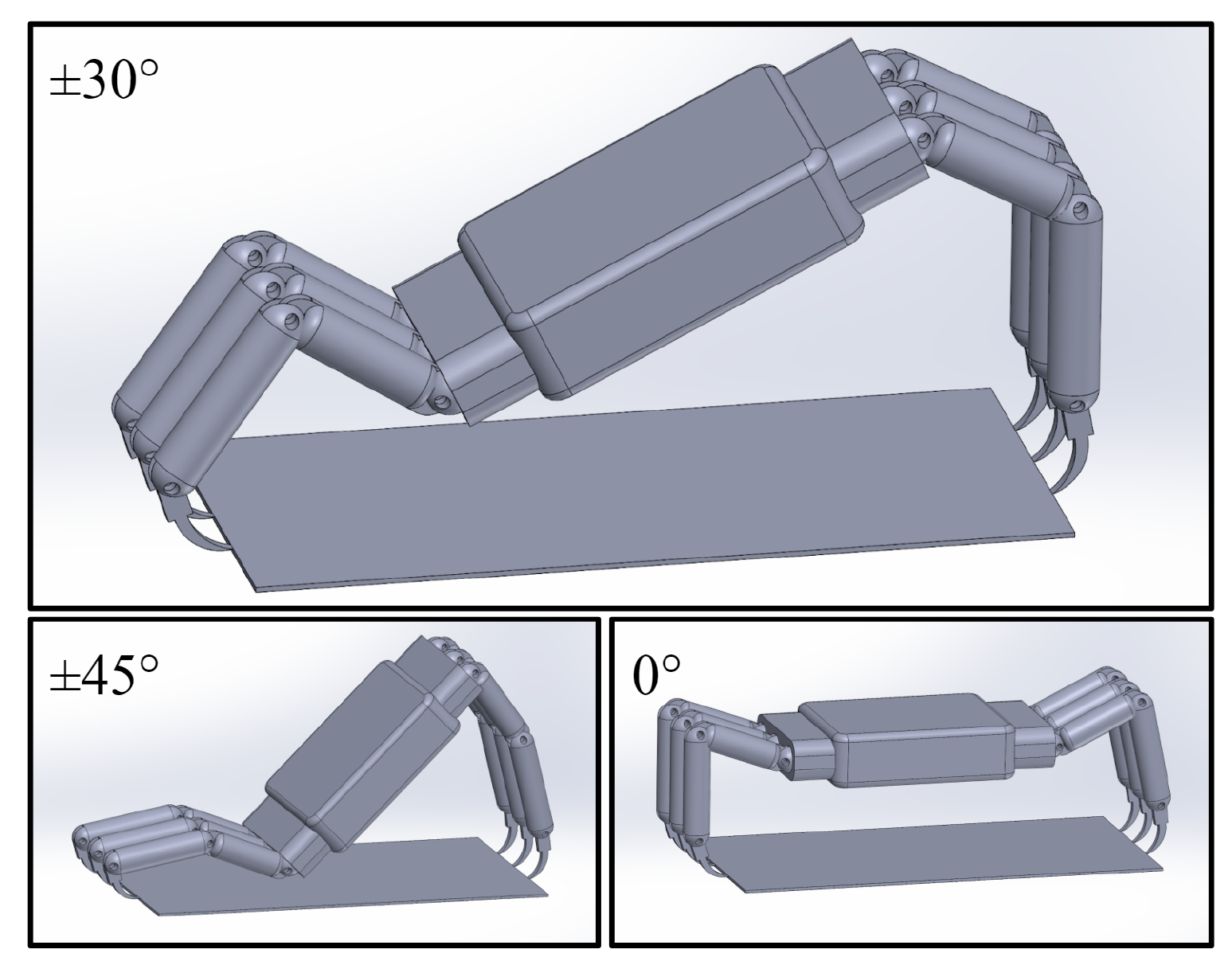
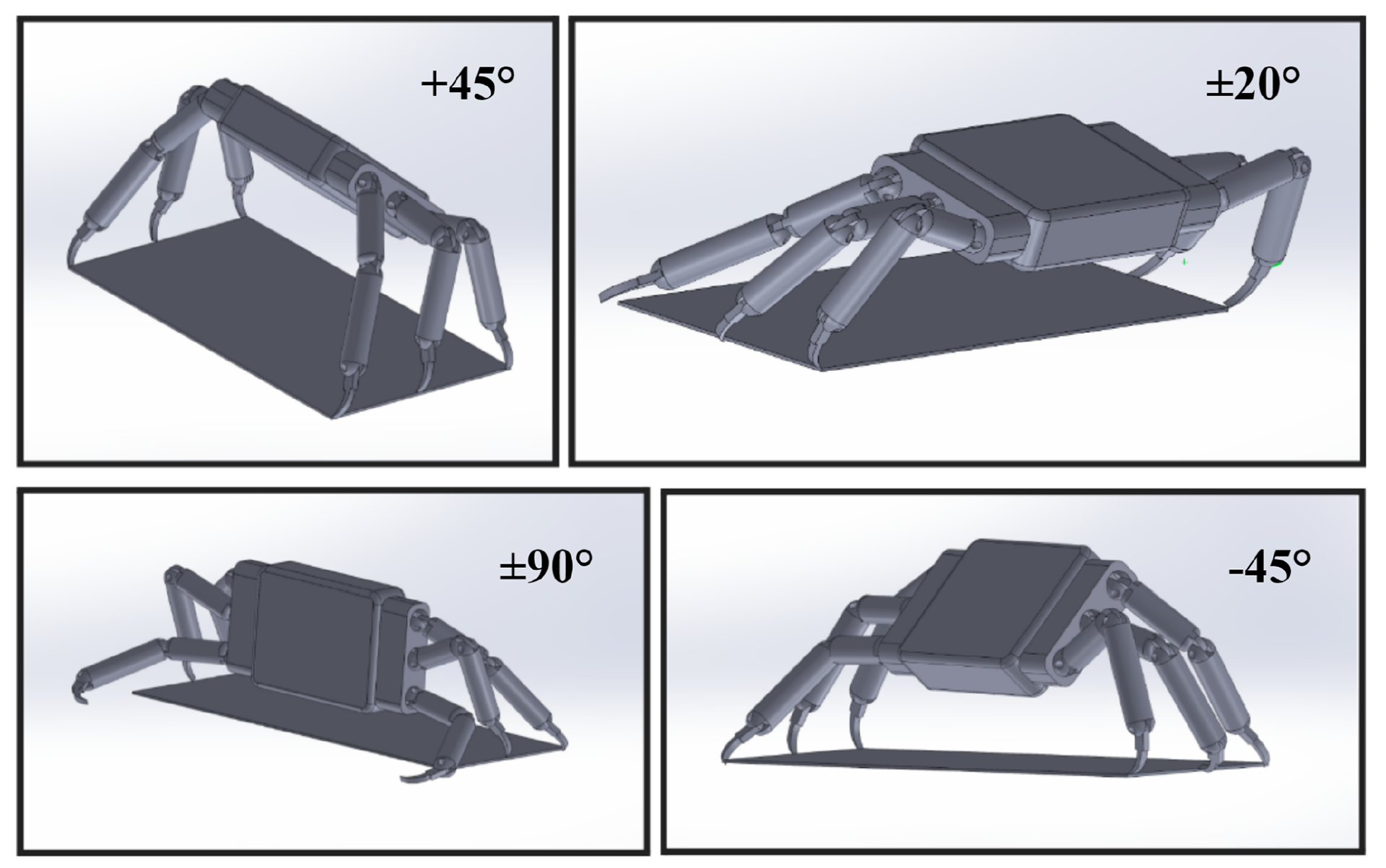
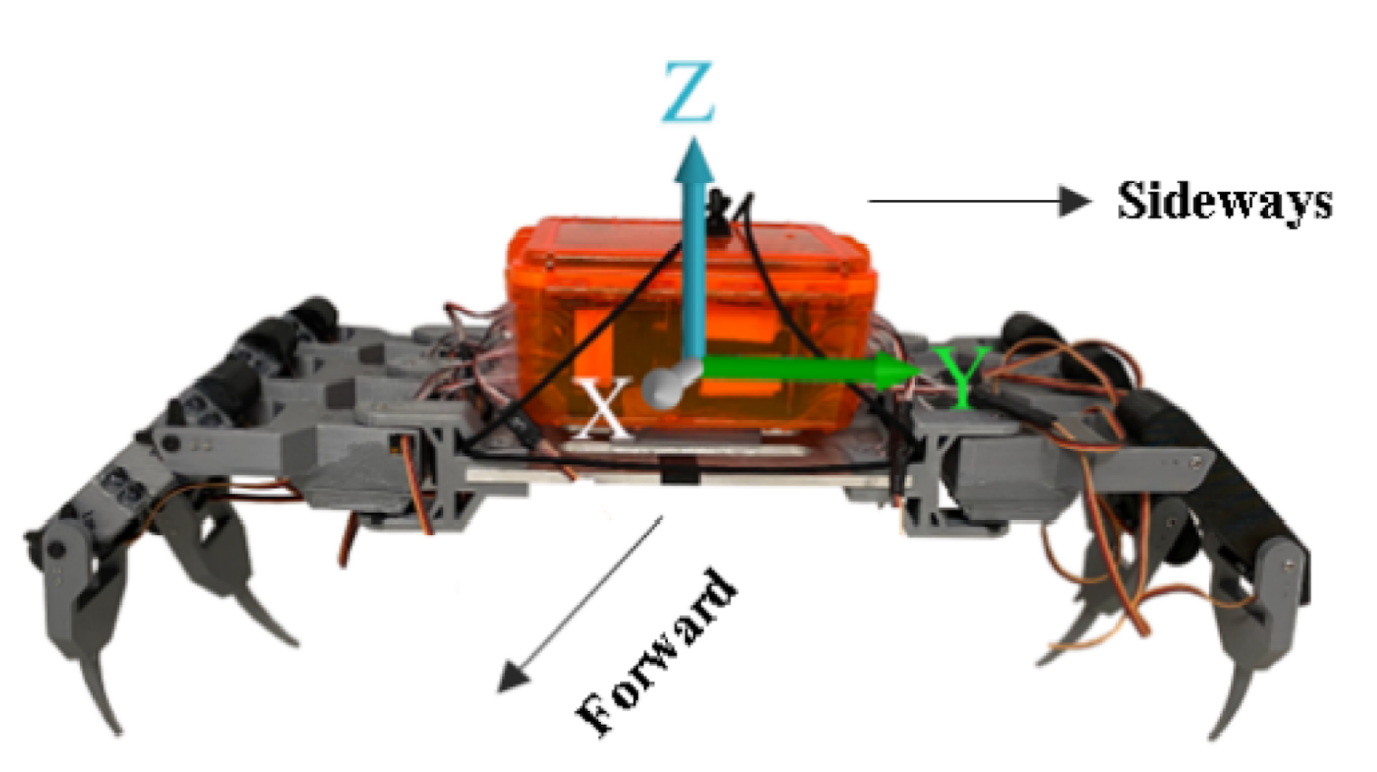
This is the contribution. Tilting in the forward direction requires each leg to rotate longitudinally at the shoulder, which no previous platform in the lab could do. I designed a hip joint where a servo sits atop a machined ABS block that doubles as the bushing for the leg axle, with rotation transmitted by meshing the servo gear against a leg gear. Six of these, driven together with six independently computed gait heights, set the body to a commanded azimuth. Superimpose azimuth and elevation and the body can hold a stance rotated about two axes at once, the case that matters when you're walking at an angle to the waves rather than straight into them.
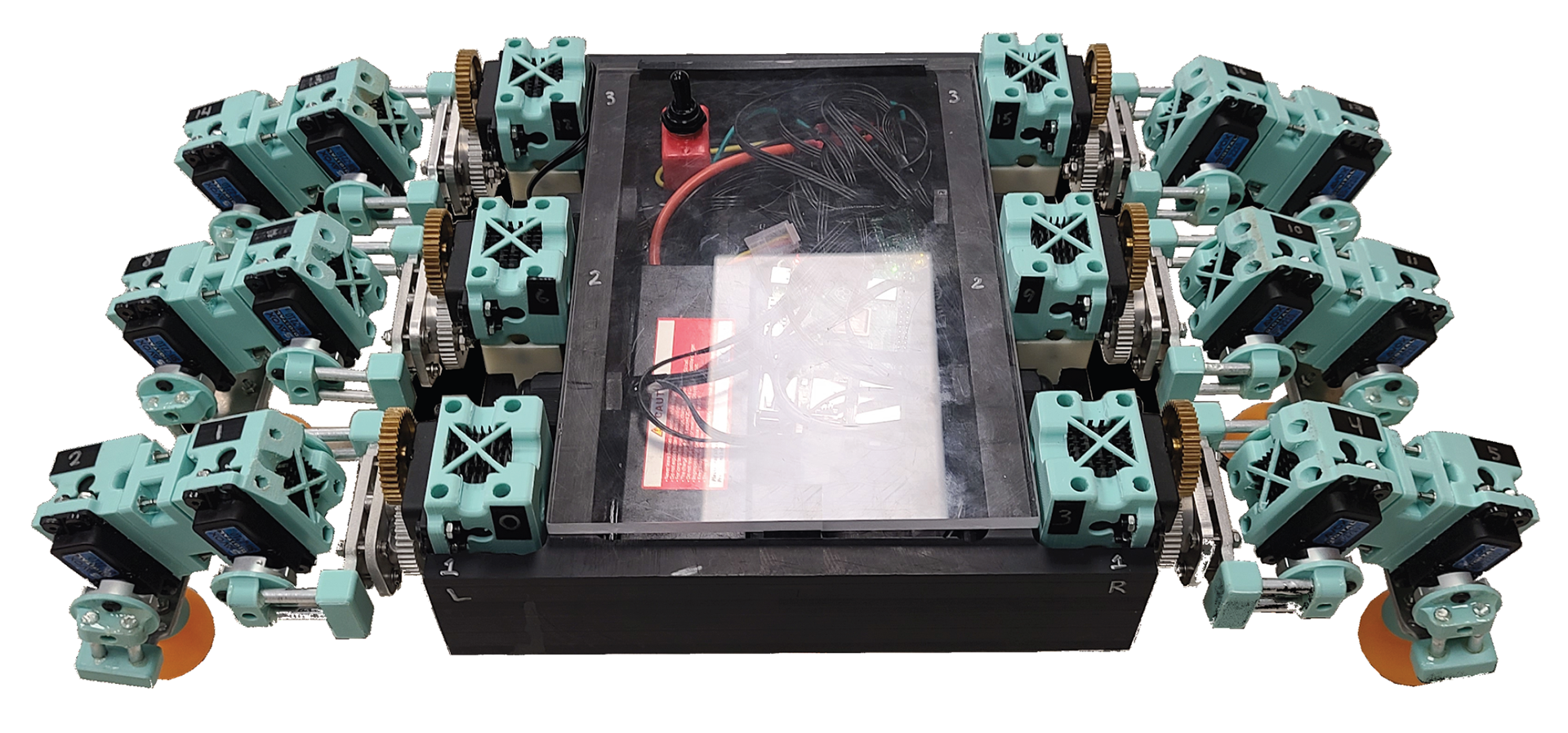
The hexapod robot I developed, with an extra 6 DOF for testing body angling
Built primarily from PLA printed at 70% infill, aluminum rod, waterjet-cut aluminum sheet, and a body machined from a single block of ABS. Design tenets were strength, modularity, and efficiency: every servo lives in a module with two integrated heatsinks that bolts to the rest of the leg, so a joint can be replaced, or a seventh degree of freedom added, without redesigning the leg. Machining the body from one block keeps waterproofing simple, with external wiring fed through glands into a chamber holding the Raspberry Pi, servo controller, power switch, and Li-Po battery. Tamatoa is negatively buoyant without added ballast, because the internal chamber is smaller and the components denser.
Dry-land results from the summer. Tamatoa walks with commanded azimuths up to 20° in either direction from parallel, holding within roughly ±1° of the target throughout locomotion.
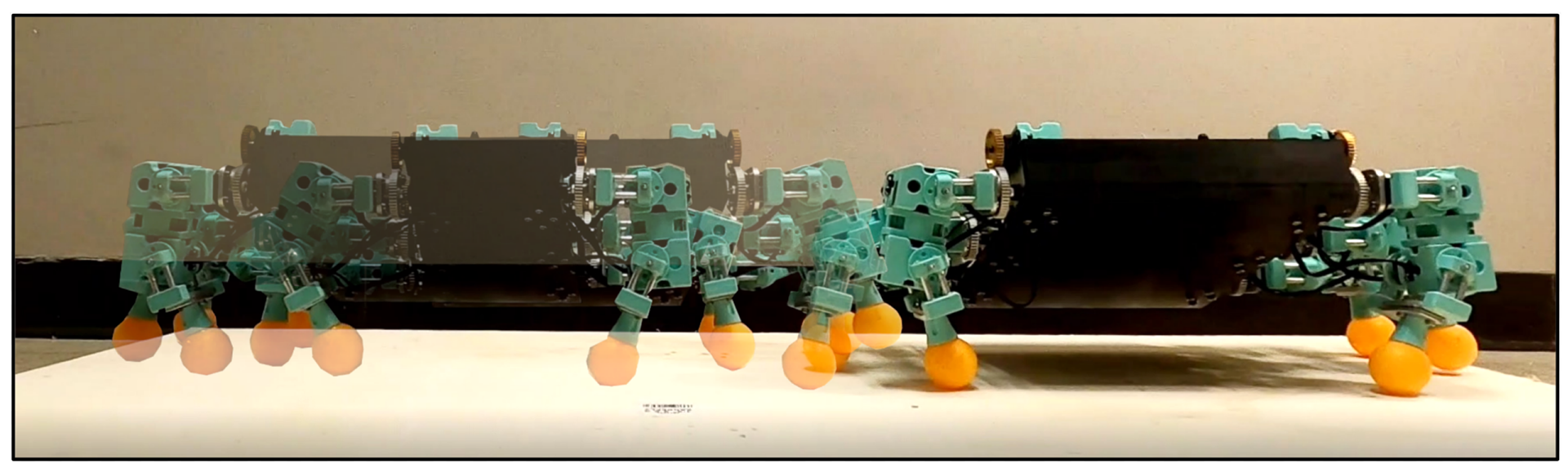
After this, I did some basic underwater testing but did not get much data, and then I graduated. Luckily, my project was picked up by a masters student, Zach Silberstein, who used the research platform to collect data on different types of walking gaits! The following figures are from the conference paper listed at the top of the document
Crabs resist being dislodged by pulling *inward* with curved dactyls, wedging themselves into the sand, a strategy the lab calls distributed inward gripping. But where in the gait cycle should a robot grip, and with which legs? Six foot paths, tested submerged in sand both in still water and under generated waves.
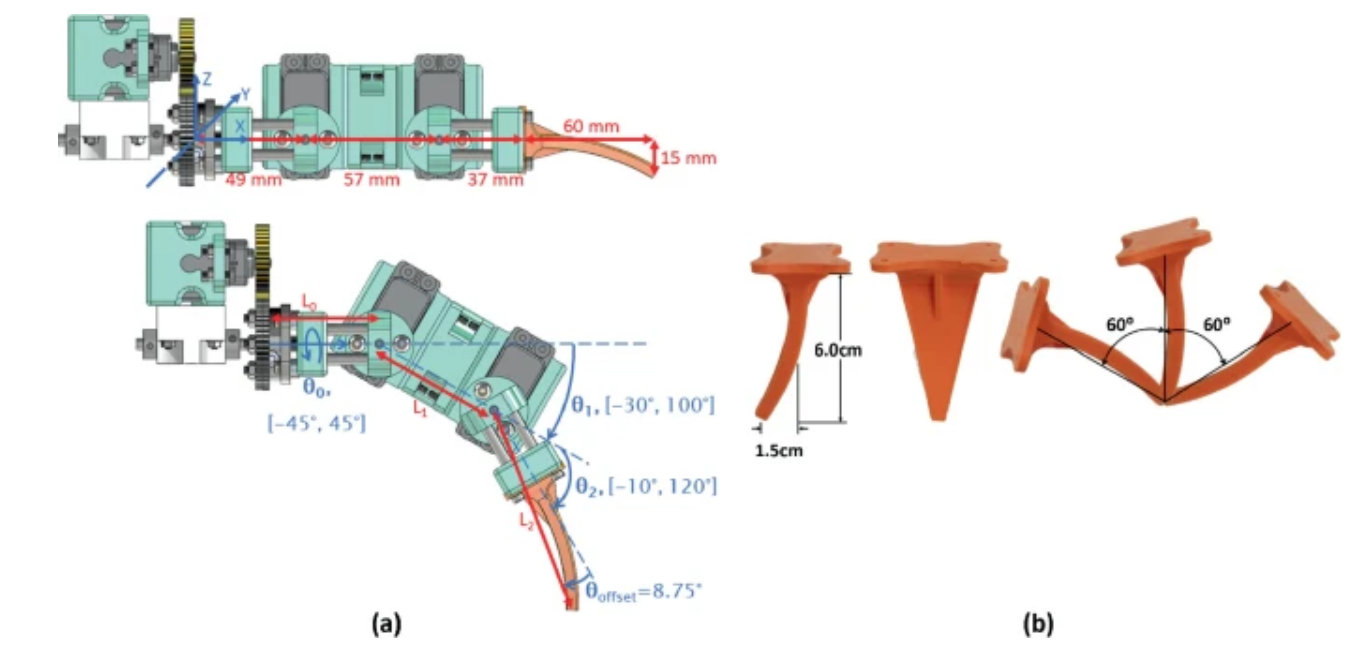
Each leg has a hip joint about the *x*-axis and parallel knee and ankle joints about *y*. Segment lengths follow the 0.63 distal-to-total ratio found optimal in earlier crab-leg work, and the hip is geared 1.2:1 for torque. The dactyl is 6.0 cm long with a 1.5 cm inward curve, big enough to bite into sand and generate real gripping force, but not so big that it sinks and forces the whole foot path higher. A constraint keeps the dactyl within 30° of the ground so it never enters the sand at a bad angle.
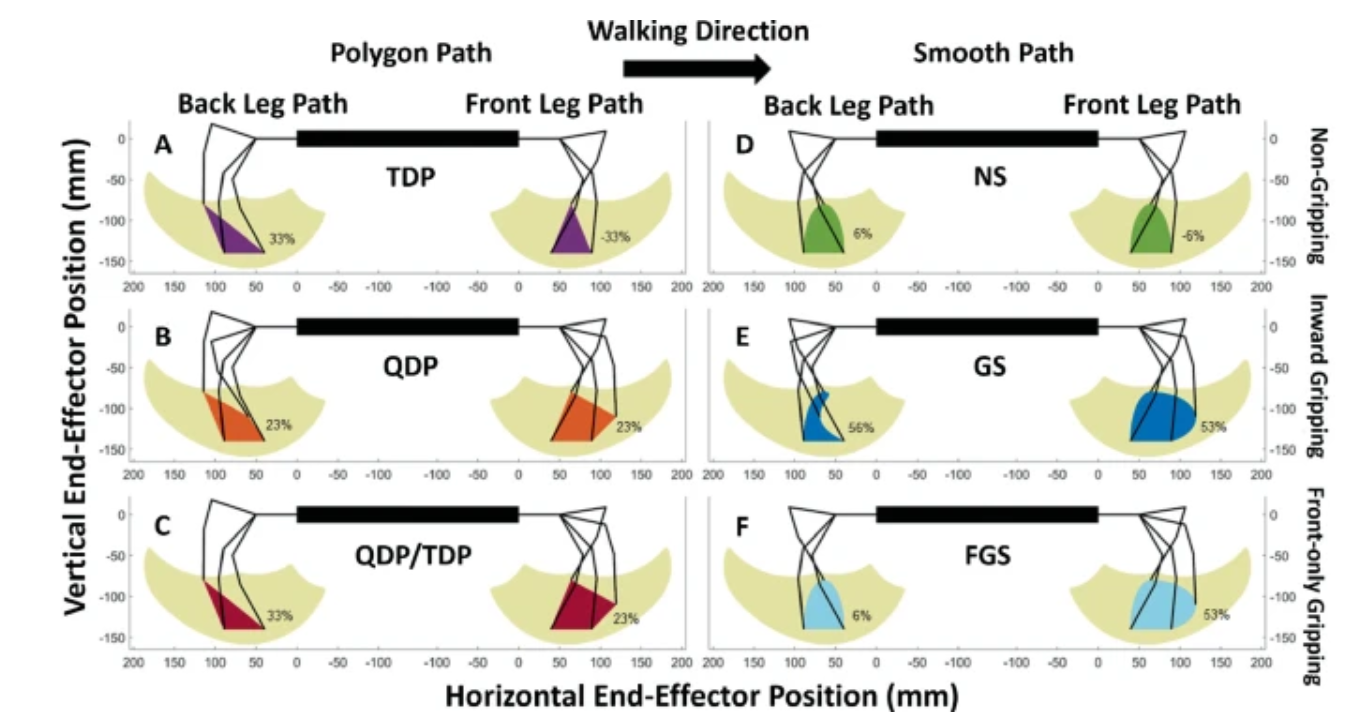
All six gaits share the same stance line, the same 14.0 cm body height, the same 6.0 cm foot raise, and the same 2 s period. The *only* thing that changes is the swing path. Three are built from straight line segments (TDP, QDP, QDP/TDP) and three from smooth curves (NS, GS, FGS). Three grip inward, three don't, and two grip with the front legs only. Gripping paths reach out past the start of stance during swing, plant, then pull 3.0 cm inward, mimicking the inward gripping strategy that raises effective weight in granular media.
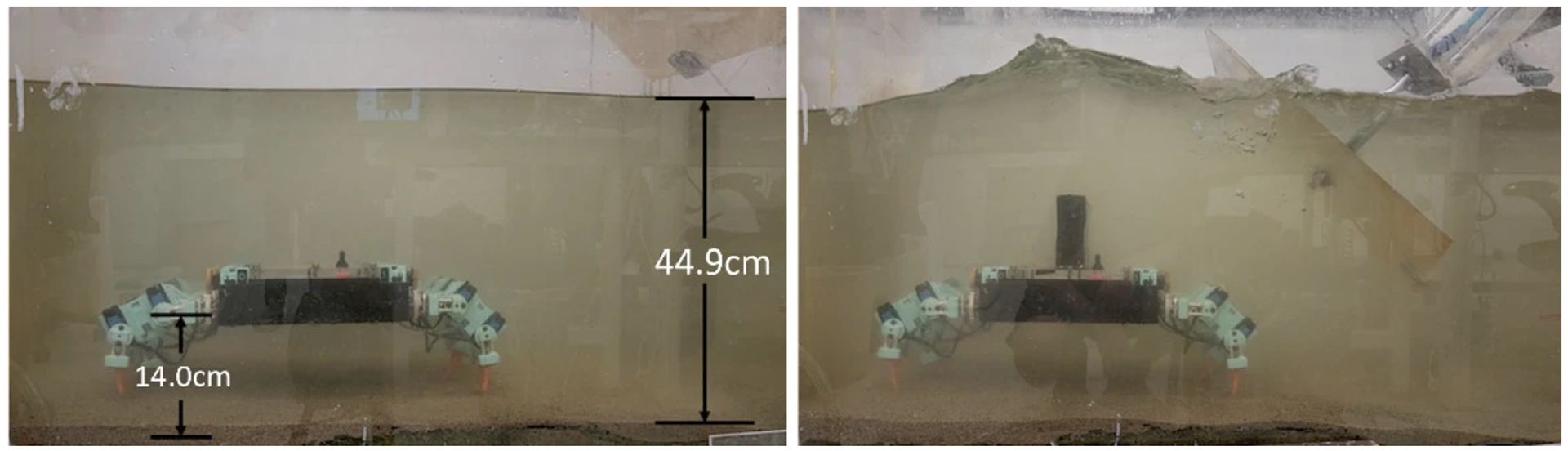
Trials ran in a wave tank over 20 cm of play sand under roughly 45 cm of water, deep enough to fully submerge the robot. An overhead GoPro recorded each run and displacement was digitized frame by frame; an onboard current sensor logged servo power at 20 Hz for cost of transport. For wave trials, a pneumatic piston drives an acrylic plate into the water on a 3.6 s period.
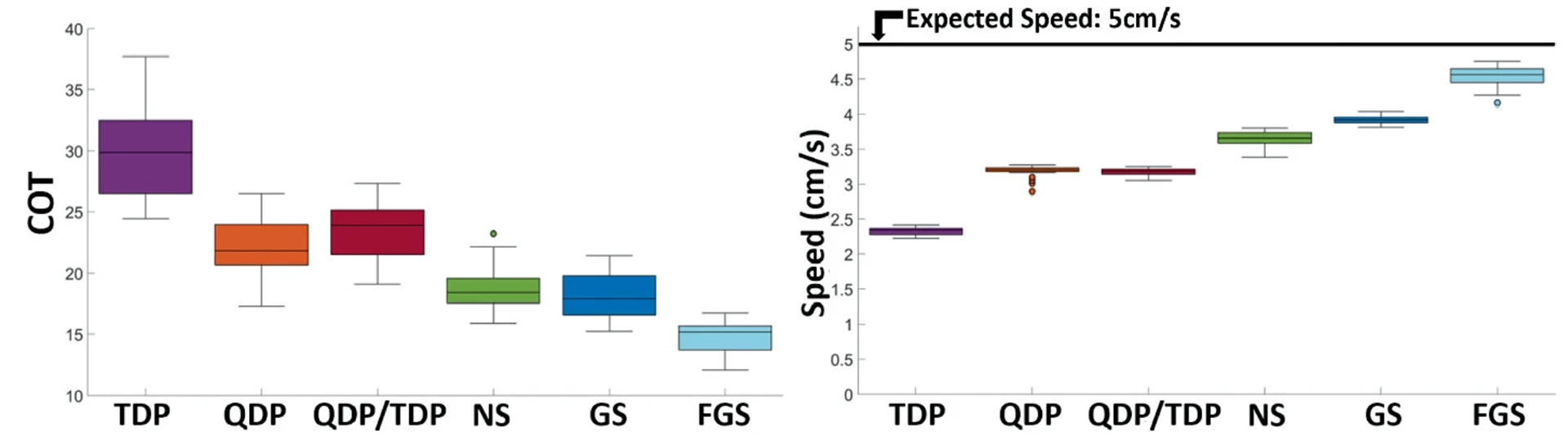
Gripping performs better than not gripping (QDP over TDP, *p* < 10⁻¹⁵). Smooth curves perform better than polygons across every matched pair. And front-only gripping performs best: FGS is the fastest and most efficient gait tested at 4.5 cm/s, 91% of the geometrically ideal speed, with a cost of transport of 14.7 against 29.8 for the baseline TDP. Critically, QDP/TDP performs statistically identically to QDP (*p* = 0.63), which shows the benefit of gripping was coming from the front legs all along; the rear legs were just paying for it.
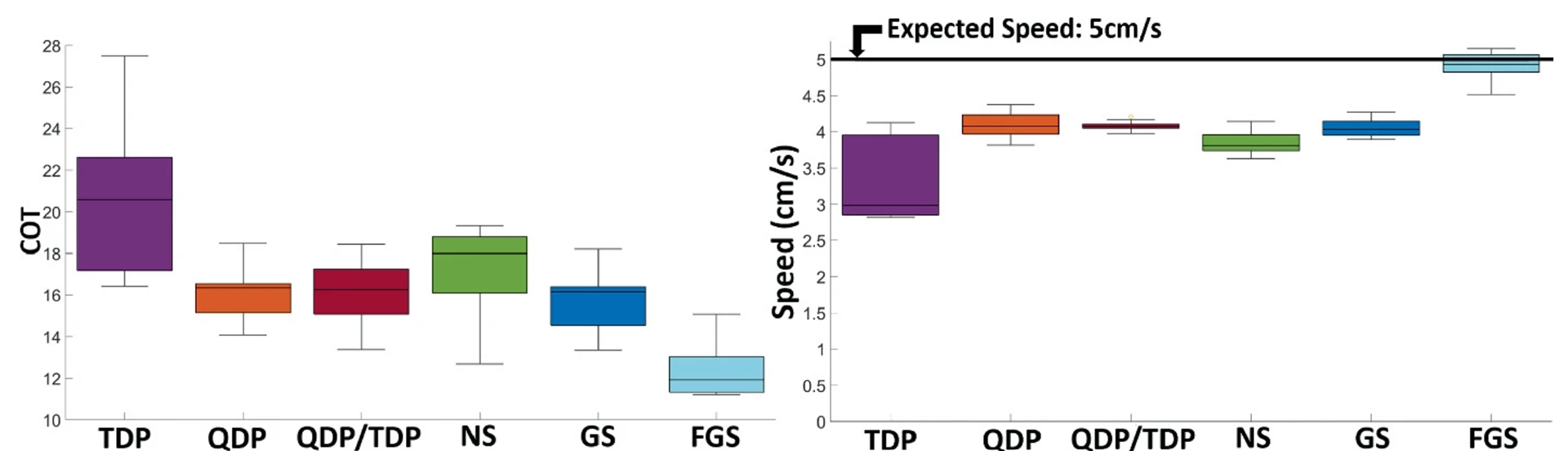
With waves, FGS reaches 4.9 cm/s at a cost of transport of 12.3, roughly 29% more efficient than QDP. Among the gripping gaits, GS and QDP are indistinguishable (*p* = 0.71 for speed).
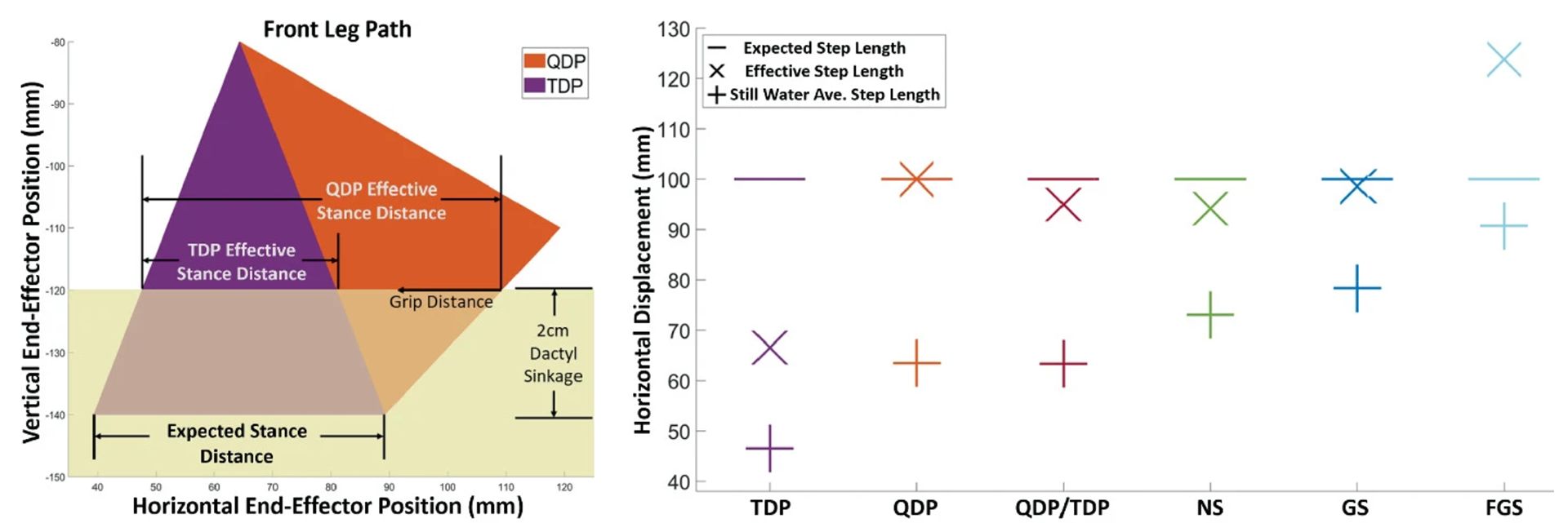
A gripping foot reaches out farther during swing, so even with 2 cm of dactyl sinkage it plants beyond where a non-gripping foot would, giving a longer *effective* stance and so a longer stride, before any gripping force is counted. But when the rear legs grip, they enter the sand before reaching the start of stance and drag backward
I would love at some point to see the robot be used for the original purpose it was designed for: rotating hip angle in waves to minimize COT, using the downward force of water on the angled body to keep the robot pressed against the ground so it doesn't need to grip as hard.