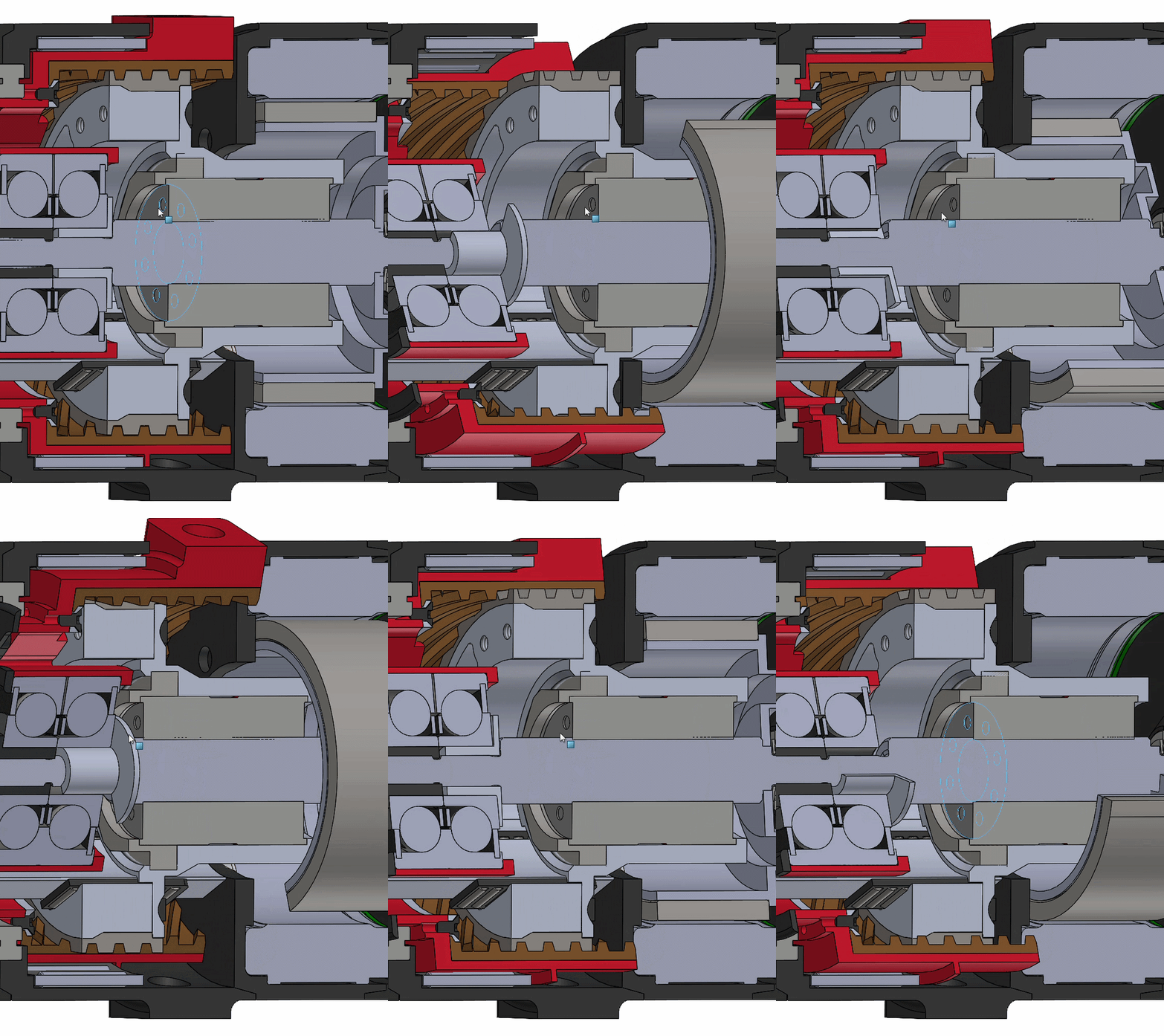
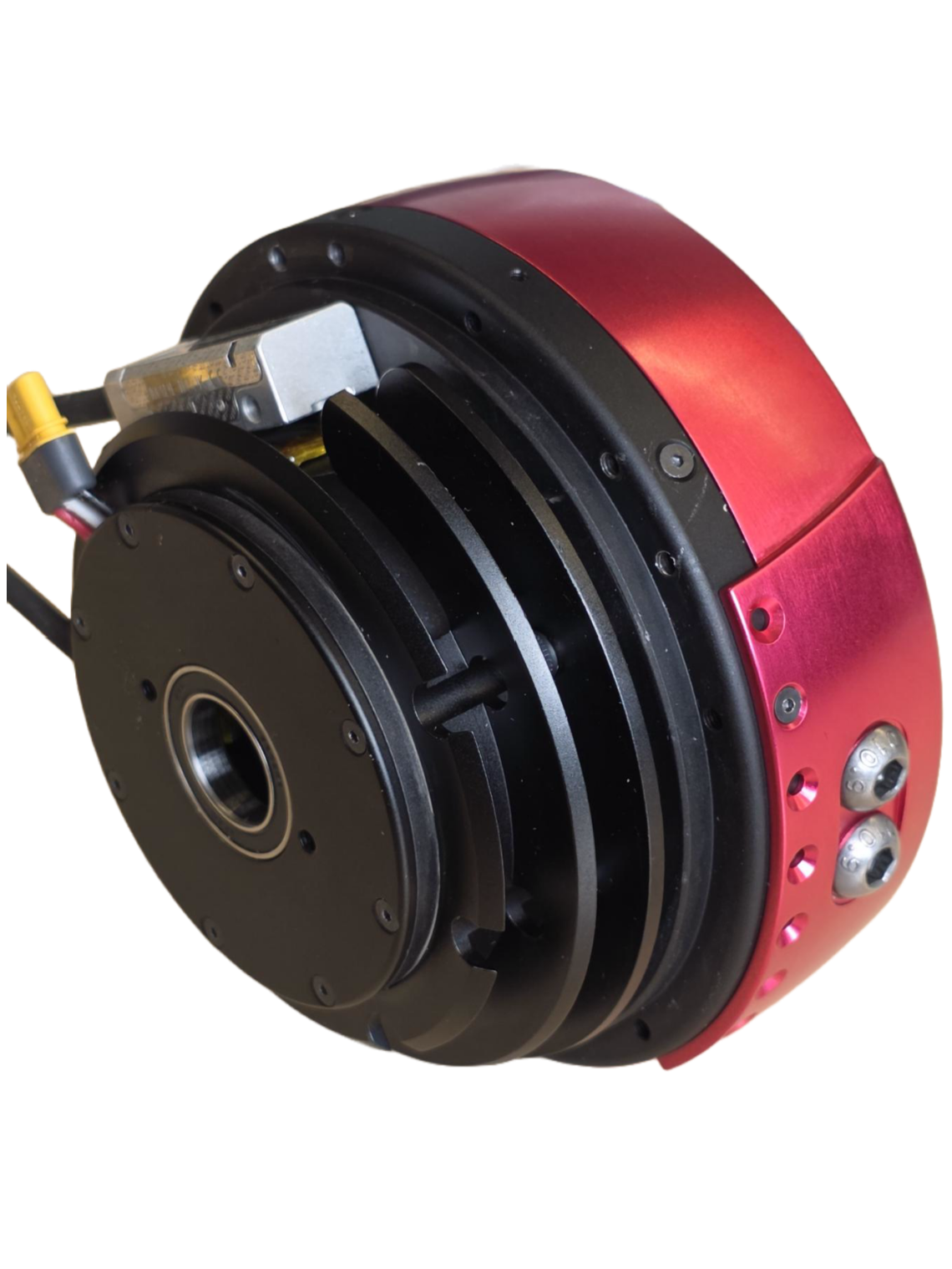
Nathan Carmichael and Max K. Shepherd · Shepherd Lab, Northeastern University · Journal paper in preparation for IEEE Transactions on Robotics · Conference paper submitted to IEEE-RAS Humanoids 2026 · Poster presented at the IROS 2026 State of the Art in Robotic Leg Prostheses workshop · Supported by the NSF Graduate Research Fellowship Program and the National Institutes of Health
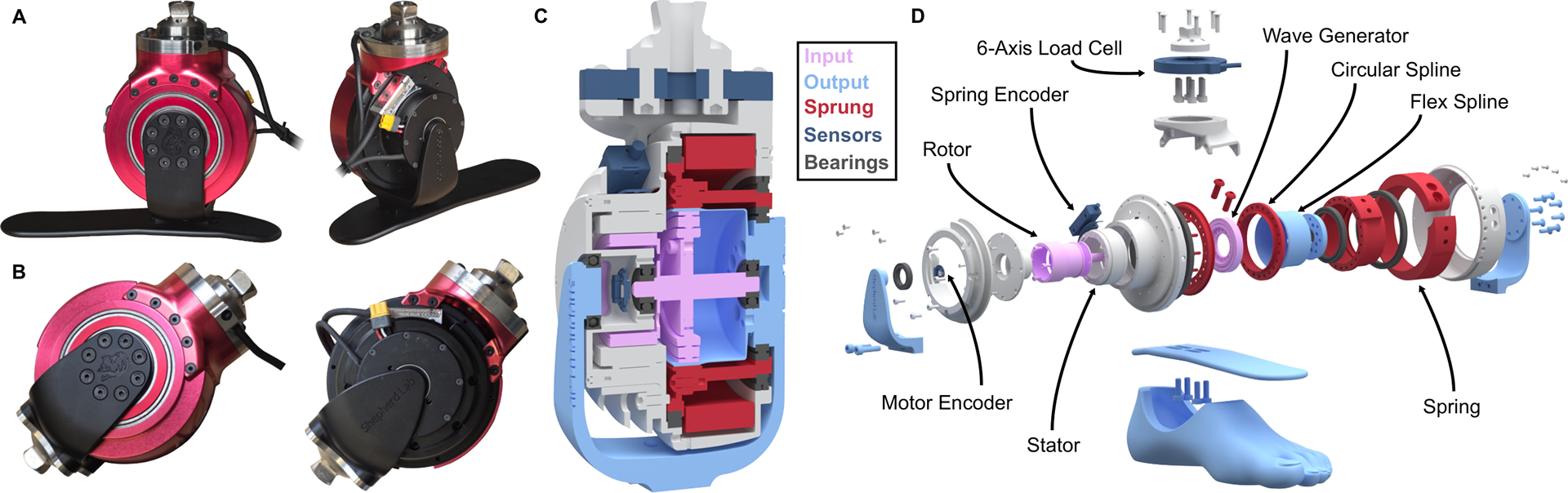
(A) Ankle and (B) knee configurations of the same actuator. (C) Section view, colored by function. (D) Exploded view of the ankle with the major components labelled.
Almost every prosthetic ankle and knee prescribed in the United States is passive, and a passive joint cannot add the net-positive work that level walking, ramp ascent and stair ascent require. A powered joint must produce biological torque in a package narrow enough to clear the other ankle during swing. It must also control that torque accurately, against the ground in stance and at near-zero impedance in swing. A small motor behind a high-ratio rigid drivetrain gives the torque at low mass, but transmission friction makes motor current a poor estimate of output torque.
I designed a differential elastic actuator (DEA) that measures output torque with a single encoder on the housing, which reads the deflection of a spring. The 50:1 harmonic drive keeps its torque density, and transmission friction no longer enters the torque signal. The actuator produces 122 N·m of peak torque at 980 g and 65 mm of mediolateral width, and the same actuator, spring included, mounts as either an ankle or a knee.
The benchtop characterization below is complete. The IRB has approved the human-subjects protocol, and the ambulation trials are pending. For more specific actuator data, please see the "Differential Elastic Actuator" Project
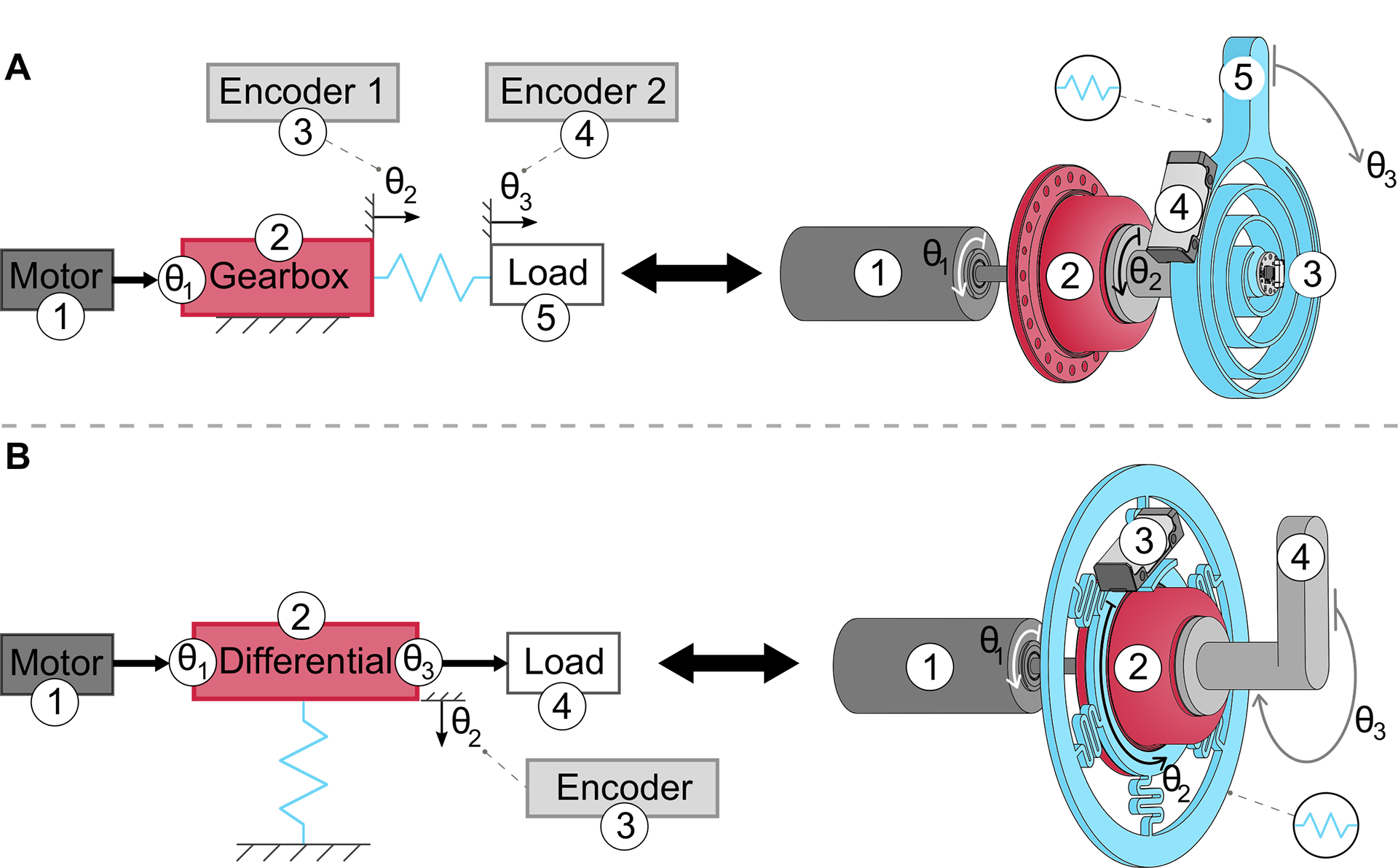
In a series elastic actuator (SEA), the spring sits in the load path, so measuring its deflection takes two encoders, or one encoder that rotates with the output and needs a cable path through the joint. A DEA grounds the spring against one port of a differential, which in this actuator is the circular spline of the harmonic drive. The transmission body then rotates against the spring in proportion to output torque, and one static encoder on the housing reads that rotation. Because the spring is referenced to ground, it can sit around the transmission inside the diameter the transmission already occupies, so the spring adds no width to the joint.
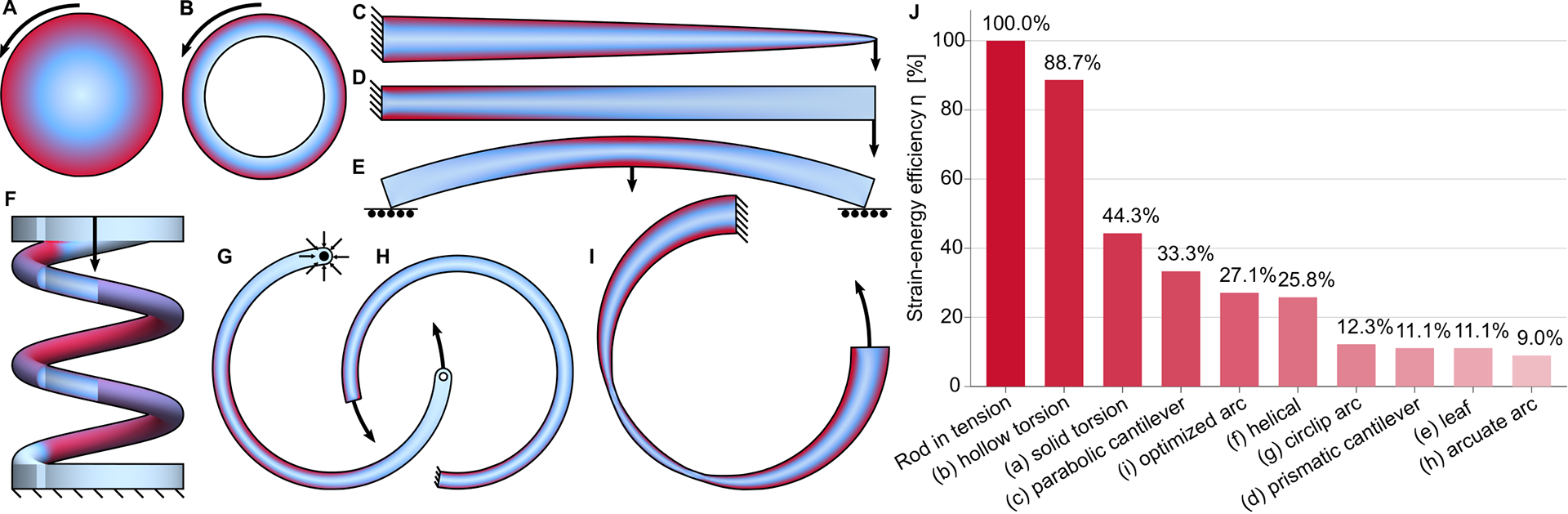
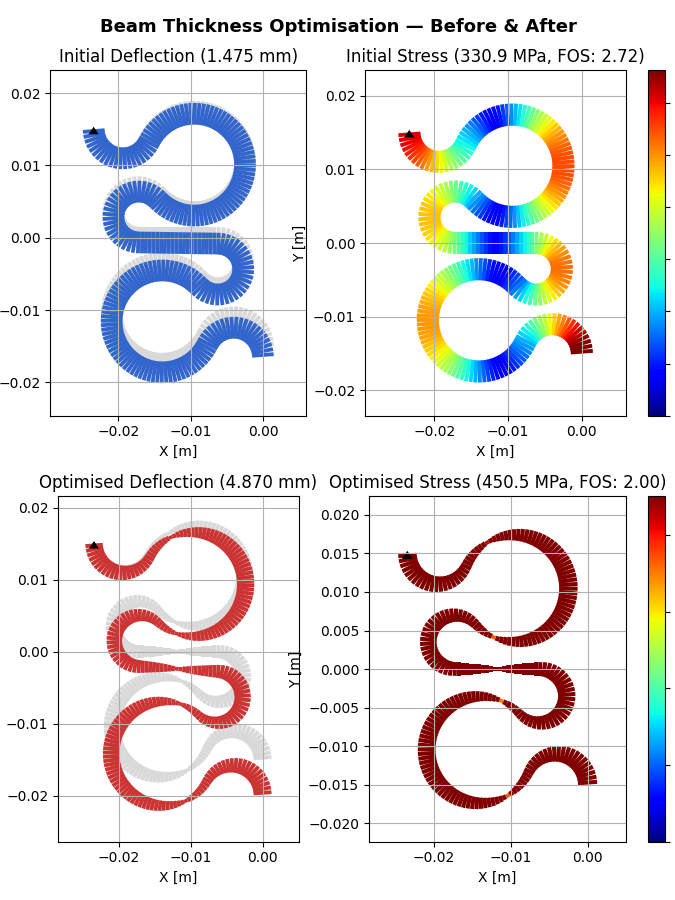
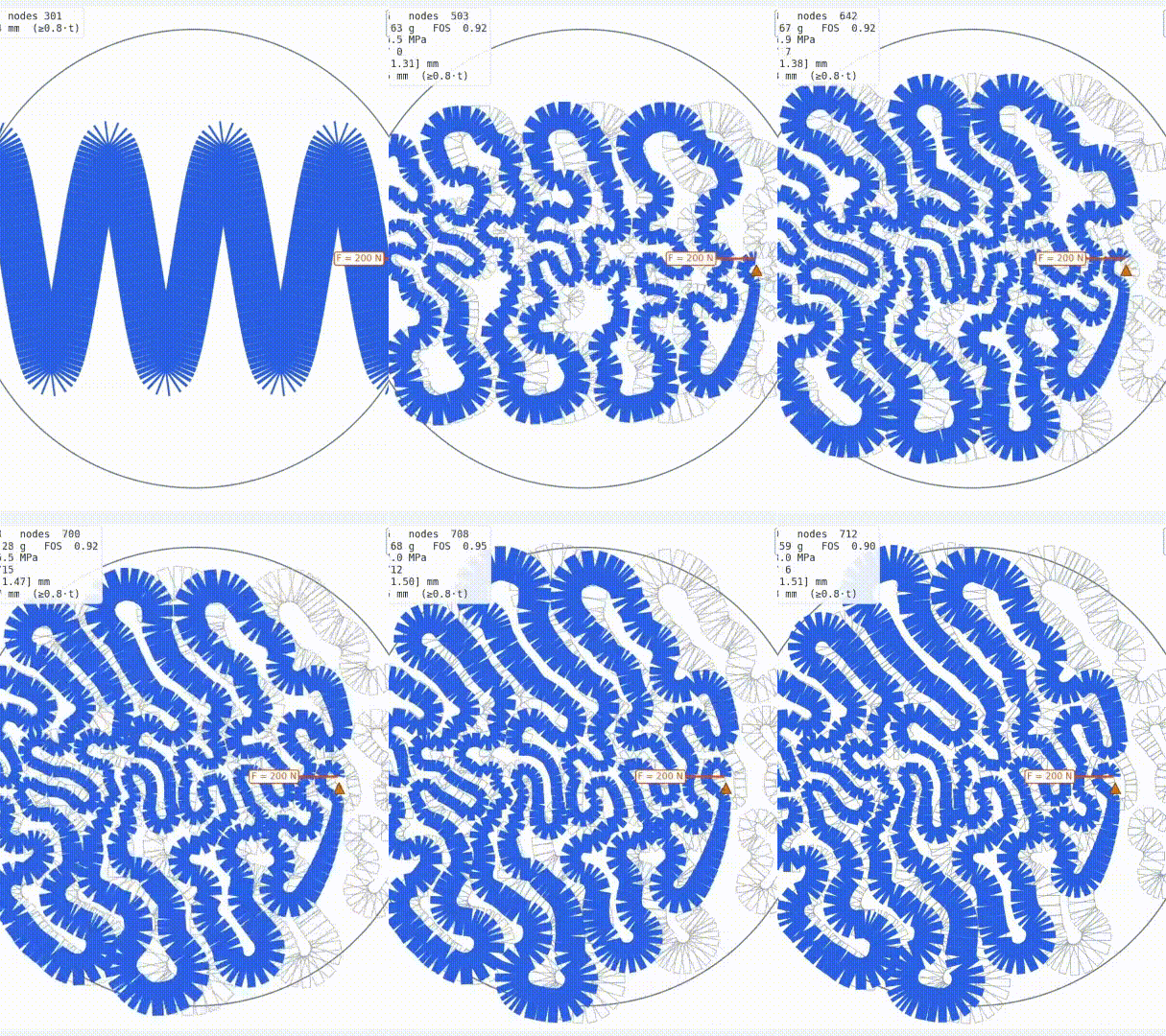
Minimizing mass at a fixed allowable stress is the same problem as maximizing stored energy per unit mass. I defined the energy-storage efficiency, η_U, as the strain energy a geometry stores divided by the energy it would store if all of its material were at the peak stress. η_U depends only on the shape of the stress field, so it does not change with load, material or scale. A rod in tension reaches 100 %. In bending, stress falls to zero at the neutral axis, so a rectangular section reaches at most 1/3 whatever its thickness profile along the span. A uniform cantilever reaches 11.1 % and a parabolic cantilever reaches the full 33.3 %. The optimized arcuate spring reaches 27.1 %, which is 3.0 times the 9.0 % of a constant-thickness arc in the same envelope and 81 % of the rectangular-section ceiling.
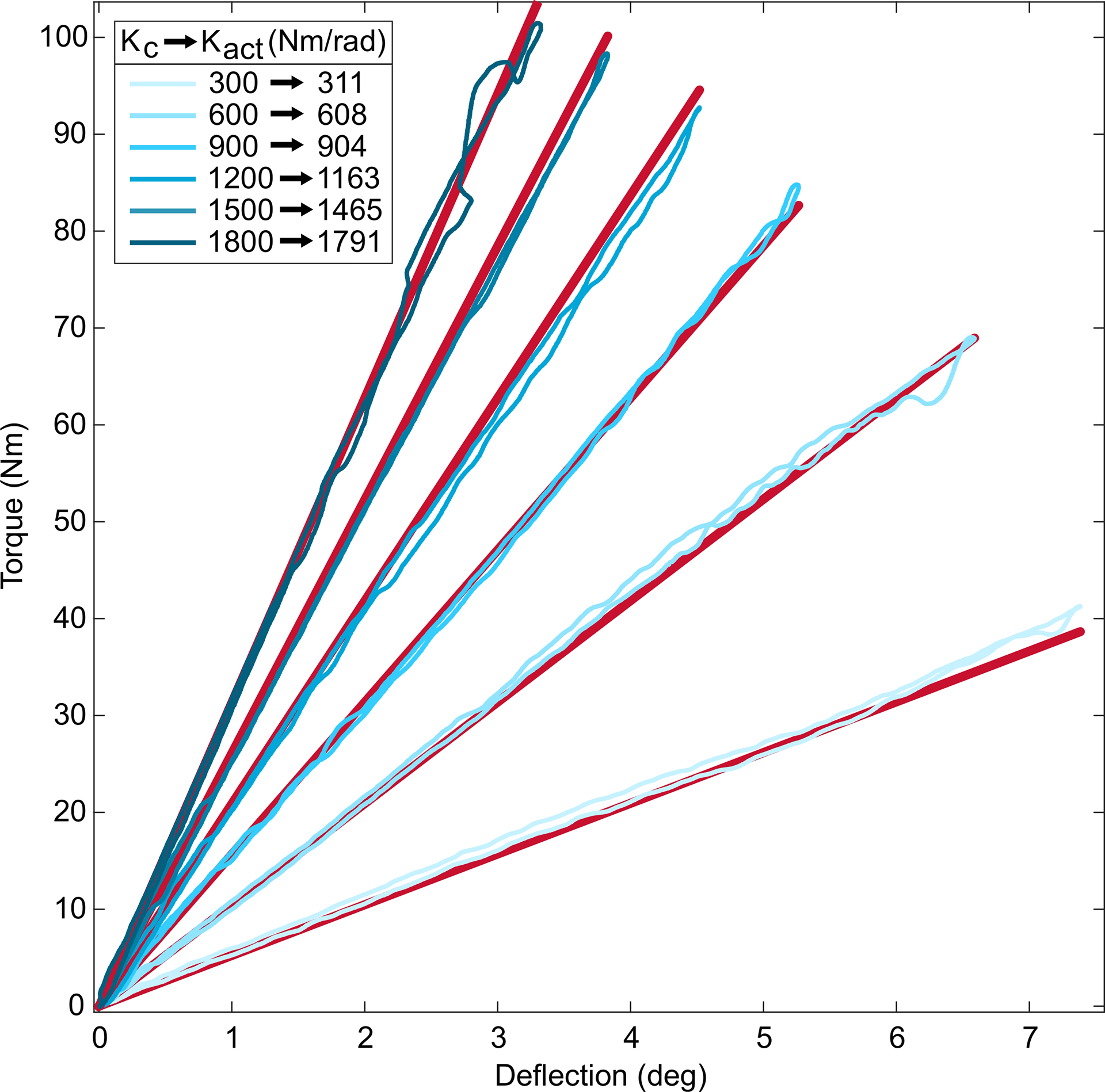
A prosthetic joint is usually prescribed as an impedance, so the last bench test checked whether the actuator renders the stiffness it is commanded. I commanded six stiffnesses from 300 to 1800 N·m/rad, backdrove the actuator on the dynamometer, and took the rendered stiffness as the least-squares slope of reference torque against deflection. Every rendered stiffness was within 3.7 % of the command, with a mean absolute error of 1.9 %. The largest error is smaller than the 8 % change in ankle stiffness that people with amputation can detect. I expected accuracy to degrade above the 1480 N·m/rad physical spring stiffness, where the motor must actively resist deflection. However, the 1500 and 1800 N·m/rad conditions stayed within 2.3 % of the command.
Paper coming soon!